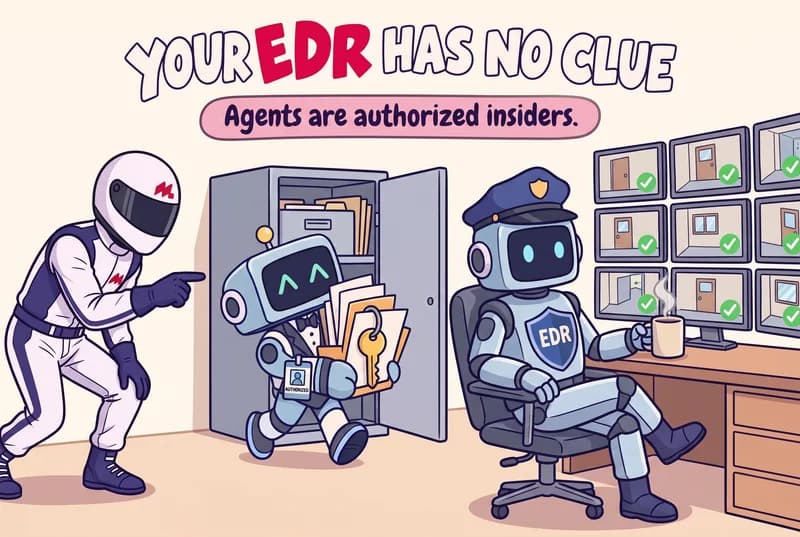
EDR sees the process. Not the agent.
EDR watches processes, files and network activity on the machines it sits on. To it, an AI agent is one more process: it sees the agent start, not the session inside it. And the agents that run in someone else’s cloud never touch the endpoint at all.
EDRendpoint detection and response
 runtime, inside the agent
Coverage
Partly covered: Agents running on managed machines, seen as processes.
Covered: Every agent where it runs: endpoints, browsers, VMs and the cloud.
Inside the session
Partly covered: The process starting, and its file and network activity. Not the decisions behind them.
Covered: Every tool call, MCP request, file action and command, captured inside the session.
Supply chain
Not covered: Another file on disk or another child process, with no view of what it gives the agent.
Covered: Inventoried per agent, including ones never run, and scored by Manifest.
Identity
Partly covered: The user account on the machine.
Covered: The person the agent acted for, and the account behind it, personal accounts included.
Agents in the cloud
Not covered: Agents that run in a vendor’s cloud, like personal agents over iMessage or WhatsApp, never reach the endpoint.
Covered: Agent use found across your environment, with what each agent has connected.
Responses
Partly covered: Kill the process or isolate the machine.
Covered: Alert, advise, correct, ask the user, block the call or end the session, inside the harness.
Keep your EDR. Manifold connects the security stack you already have, from identity and EDR to MDM, and adds what happens inside the agent.
See Manifold in action.
A short tour of the platform, from the first agent discovered to the first policy enforced.